
Guesty vs Cloudbeds: Which PMS is best for your rentals?
The essential takeaway: Guesty is the specialized engine for vacation rental scaling, while Cloudbeds remains hotel-centric. This distinction provides you with native tools like trust accounting and owner portals, eliminating complex third-party integrations. 🚀 It pays off: Guesty’s 250-person R&D team drives an impressive 24.6% average portfolio growth for professional managers.
Are you tired of manual tasks and wondering if guesty vs cloudbeds is the key to scaling your property business without the constant operational headaches? This guide compares both industry giants to help you choose the specific software that perfectly aligns with your unique portfolio, whether you manage boutique hotels or a massive vacation rental empire. You will discover how Guesty’s native automation and team of 250 experts can help you outperform the market and achieve that impressive 24.6% growth that professional managers are already seeing every single day across their portfolios 🚀.
- Guesty vs Cloudbeds: Choose Based on Your Property Type
- Automation and Daily Operations: Who Handles the Heavy Lifting?
- 3 Ways These Platforms Handle Your Money and Owner Reports
- Support and Scalability for Your Growing Portfolio
Guesty vs Cloudbeds: Choose Based on Your Property Type
Both platforms lead the market, but their DNA dictates whether they fit a boutique hotel or a sprawling vacation rental portfolio.
Guesty
Vacation rental specialist, 500k listings, growth engine focus.
Cloudbeds
Traditional hotel heritage, boutique hotels/hostels, room-based focus.
Here you can more details on our Guesty test and our Cloudbeds review.
Short-term rental focus vs traditional hotel heritage
Guesty was born for vacation rentals and now manages 500,000 listings effectively. Cloudbeds has its roots in traditional hospitality like hotels and hostels. They serve very different masters.
This history shapes the software design. Guesty prioritizes multi-unit flexibility, whereas Cloudbeds is built for room-based inventory.
Professional managers find more room to scale with Guesty’s complex property handling. Cloudbeds relies on a classic hotel-centric workflow. It is built for a different type of operation.
Choose wisely. Your primary inventory type should dictate your final choice.
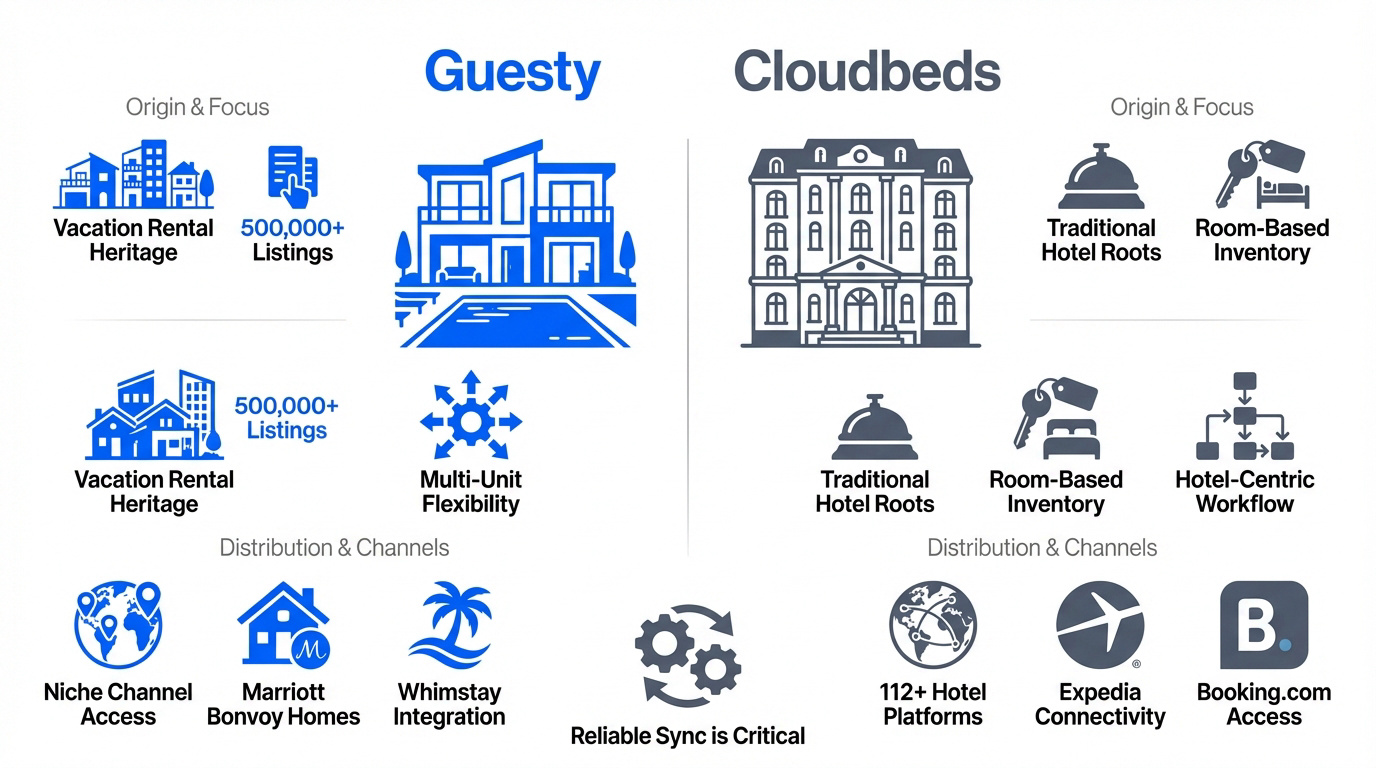
Distribution power and niche channel access
Channel reach differs significantly between these two platforms. Guesty opens doors to niche vacation sites like Whimstay for last-minute revenue. Cloudbeds connects to 112 hotel-heavy platforms. Your specific guest demographic should drive this decision.
Consider the Marriott Bonvoy integration. Guesty provides a direct path to Homes & Villas. This is a huge win for high-end operators seeking corporate guests.
- Guesty’s niche channels (Whimstay, HVMB)
- Cloudbeds’ hotel focus (Expedia, Booking.com)
- Reliability of high-frequency synchronization
Automation and Daily Operations: Who Handles the Heavy Lifting?
Moving from distribution to daily grind, the real winner is the software that deletes manual tasks from your calendar.
Unified inbox and AI-powered guest messaging
Guesty’s native unified inbox centralizes all guest communication in one place. It handles inquiries across multiple channels without switching tabs. This keeps your workflow efficient.
Cloudbeds relies on the Whistle app integration instead. While Whistle is powerful, it remains a third-party tool rather than a native feature.
Guesty uses AI to suggest responses and automate replies for routine inquiries. This saves hours for property managers during peak check-in times. It ensures consistency.
Mobile app functionality is vital. Real-time management keeps your teams on the move and responsive.
Tech Note
Guesty uses a native app for management; Cloudbeds relies on Whistle for messaging.
Task management for housekeeping and maintenance
Guesty allows for complex task triggers based on check-out times. Cloudbeds offers task tracking but is often viewed as more hotel-centric. This affects how multi-location portfolios coordinate staff.
Guesty’s native integrations allow for automatic code generation. This eliminates the need for manual key handovers or separate lock management software.
- Automated cleaning schedules
- Smart lock code generation
- Maintenance ticket tracking
- Mobile staff alerts
Operational Workflow
1. Check-out trigger. 2. Task assignment. 3. Code expiration. 4. Ticket generation.
When comparing guesty vs cloudbeds, native automation usually wins the day for busy property managers. In this case, choosing Guesty means choosing less manual work.
3 Ways These Platforms Handle Your Money and Owner Reports
Operations keep the lights on, but robust financial tools are what actually keep the business profitable and compliant.
Native trust accounting vs third-party integrations
When comparing guesty vs cloudbeds, Guesty builds financial compliance right into its core, while Cloudbeds relies on external connections. Having native trust accounting is a lifesaver in strictly regulated zones.
In fact, you get automated tax calculations and payment reconciliation. This setup basically removes the risk of human error in your books.
| Financial Feature | Guesty | Cloudbeds | Best For |
|---|---|---|---|
| Trust Accounting | Native | Integration | Complex Regs |
| Native Payments | Yes | No | Speed |
| Owner Payouts | Automated | Manual | Scalability |
| Tax Automation | Yes | No | Compliance |
Software must adapt to local tax laws. Otherwise, you’re just stuck doing manual entry.
Dedicated owner portals for transparency
Guesty’s portal lets owners see bookings and performance in real-time. This transparency builds serious trust and improves client retention. It’s about sharing data at the right time.
Payout schedules can be customized for different owners. This flexibility is a hallmark of Guesty’s design and overall logic.
Professional reports make you look more credible. Cloudbeds focuses more on hotel-style reporting, which may lack the specific owner-centric details that property managers actually need to provide to clients.
Bref, portals reduce the volume of owner inquiries significantly. It saves everyone a lot of time.
Support and Scalability for Your Growing Portfolio
Finally, the software you choose today must be able to support where your business will be in five years.
R&D investment and feature release frequency
When comparing guesty vs cloudbeds, Guesty puts real muscle into their tech. They employ over 250 developers, while Cloudbeds sticks with about 80. This means features drop almost daily.
Big teams listen better. Guesty pivots fast when the market shifts. This keeps your tech ahead of every new trend.
Ever heard of Guesty Capital? It is a massive advantage for funding your expansion. Cloudbeds just sells software. Guesty actually helps you buy more properties. It is built for ambitious enterprise-level portfolios.
Scalability at a Glance
Guesty R&D: 250+ developers
Cloudbeds R&D: 80+ people
Guesty Portfolio Growth: 24.6% average increase after adoption
Direct booking builders and hardware connectivity
Your website needs to sell. Guesty’s builder focuses purely on vacation rental SEO. Cloudbeds templates often feel like old-school hotel sites. They just do not convert the same way.
Tech-heavy users need freedom. Guesty’s open API offers way more depth. It is the best choice for custom, large-scale operations.
- 24/7 support availability
- API documentation quality
- SEO customization options
- Third-party marketplace size
Support matters when things break. You get 24/7 help via chat and phone.
Choosing between Guesty vs Cloudbeds depends on your specific property DNA. For vacation rental managers wanting a native growth engine, Guesty’s massive R&D power will scale your business fast. 🚀 Switch today to automate your operations and watch your portfolio thrive with total transparency.
FAQ
Is Guesty or Cloudbeds a better fit for my vacation rental business?
The question isn’t just about which software is “better,” but which one fits your specific business DNA. 🧬 Guesty was built from the ground up specifically for short-term and vacation rentals, managing over 500,000 listings worldwide. It’s designed as a growth engine for professional managers who need specialized tools like native trust accounting and owner portals.
On the other hand, Cloudbeds has its roots in traditional hospitality, such as boutique hotels and hostels. While it has adapted for the short-term rental market, its workflow remains very room-centric. If you are scaling a diverse portfolio of vacation homes, Guesty’s flexibility and specialized features usually provide a much smoother ride. 🚀
Does Cloudbeds offer a native owner portal like Guesty does?
To put it simply: no. ❌ Cloudbeds does not currently offer a native owner portal. If you manage properties for third-party owners, this means you’ll likely have to rely on manual reports or third-party integrations to share performance data, which can be a real time-sink.
Guesty includes a fully customizable owner portal natively. This allows your owners to log in and see real-time data on occupancy and revenue whenever they want. This level of transparency builds massive trust and significantly reduces the number of “how is my property doing?” emails in your inbox. 📈
How do these platforms compare when it comes to automation and AI?
If you want the software to handle the heavy lifting, Guesty has a clear advantage with its massive R&D team of 250 developers. 🛠️ It offers a native unified inbox with AI-powered suggested responses and automated guest messaging. It also features native task management for housekeeping and even smart lock integrations for automatic code generation.
Cloudbeds relies heavily on its “Whistle” app integration for guest engagement. While Whistle is a strong tool, it is still an integration rather than a fully native core feature. For managers who want a “set it and forget it” workflow where everything—from cleaning schedules to guest codes—is synced in one place, Guesty is the more robust choice. ✨
Which platform has the best distribution for reaching high-end guests?
It all comes down to your target demographic. Cloudbeds connects to over 112 channels, but many of these are focused on the traditional hotel industry. 🏨 This is great for filling rooms in a hotel, but might not be the best strategy for a luxury villa or a unique short-term rental.
Guesty focuses on about 60 high-impact channels specifically curated for vacation rentals. A major highlight is their direct integration with Homes & Villas by Marriott Bonvoy. 🌍 This gives you a direct path to premium corporate guests and loyal Marriott travelers, a niche that is incredibly difficult to access through hotel-centric platforms like Cloudbeds.
Is one platform more “future-proof” than the other for scaling?
If you are planning to grow your portfolio, Guesty is built for scalability. Users often see an average portfolio growth of 24.6% after switching. 📈 With features like Guesty Capital to help fund your expansion and an open API for custom tech stacks, it’s designed to support you from your first five units to thousands.
Cloudbeds is a solid, reliable choice for established hotels, but it lacks the specialized financial growth tools and the rapid pace of feature releases found at Guesty. With Guesty releasing new features almost daily based on client feedback, you can be sure your tech will always stay ahead of the latest market trends. 💡